


Average Salary
Average Hike
Median Salary
Median Hike
Hiring Partners
Achieve your career goals

Shravani Ponde
to
Senior Consultant
PwC, USA

Parimala Mudimela
to
Senior Data Scientist
Honeywell HTS

Somesh Sahu
to
Associate Principal Product Engineering
LTIMindtree

Anshuman Dash
as
Senior Director Delivery Head, IIoT & AI/ML
Microland

Ashok Shetty
as
Vice President Data Scientist
Swiss Re

Dinesh Ghanta
to
Senior Data Scientist
Oracle

Kavitha M
to
Vice President Data Governance
Goldman Sachs, USA.
Become an AI-Enabled Analytics Consultant
with Deep Techno-Functional Skills
Different business problems need different mental models. Learn to combine domain understanding, data science, AI engineering and consulting thinking.
The M.Sc. in Business Analytics helps participants build three-dimensional capability to solve complex business challenges
Domain & Business Understanding | Full-Stack Analytics & AI Skills | Data-Driven Business Problem Solving
Program feature
Build a lucrative career path in Analytics and Data Science with the M.Sc. in Business Analytics program. This is a 100% outcome-driven and skill-based program exclusively designed for working professionals in mid and senior positions to accomplish a smooth career transition into the highly rewarding data science field. The 24 month program is recognised by UGC and focuses on hands-on learning using proprietary or open software tools in the Analytics market today.
Industry Thought Leaders
as Mentors
Our industry mentors have decades of experience in the industry and hence participants will receive hands-on experience with various analytics applications to solve real-time business issues.
LMS with the best in
Class Resources
An integrated Learning Management System (LMS) that provides 24/7 access support to aspirants with in-class reading support, interactive resources, real case database datasets, recordings of sessions, and other resources.
Industry Grade
Projects
Real-time case studies with labs and simulations provide hands-on learning opportunities that help participants gain a thorough understanding of the subject and how it is applied in the real world.
Placements
Opportunities
The lateral placement services such as career guidance, resume building, and mock interviews with industry mentors and alumni help our participants to transition their careers and bag lucrative offers.
Why Business Analytics with RACE?
- Build Techno-Functional Analytics Capability
Develop the ability to understand business problems, work with data, apply statistics and machine learning, create dashboards, build models and translate insights into decisions. - Learn AI, LLMs and Agentic Automation for Business
The curriculum integrates machine learning, deep learning, NLP, LLMs, retrieval-augmented generation, agentic AI and business automation. - Gain Hands-on, Portfolio-Driven Learning
The programme includes mini-projects, two major capstone projects, certification-aligned labs and one research publication component. - Prepare for Microsoft-Aligned AI Certifications
The fourth semester includes certification-aligned courses for Azure AI Apps and Agents Developer Associate – AI-103 and Machine Learning Operations Engineer Associate – AI-300. - Designed for Working Professionals
Weekend sessions, LMS-supported learning, guided labs, recorded resources, mentor support and capstone reviews make the programme suitable for busy working professionals.
Hurry! Limited Seats Available
Curriculum Highlights
- 84 Credits
- 4 Semesters
- 15 Courses/Components
- 10+ Mini Projects
- 2 Capstone Projects
- 2 Microsoft-Aligned Certification Courses
- 1 Scopus-Indexed Publication Pathway
Semester 1 - Analytics and AI Foundations
The module that reframes the whole programme. It opens on data-driven decision-making and the full stack of what the words now mean — analytics, ML, deep learning, generative AI and agentic AI — including where AI-assisted decisions break down. Learners then practise business problem framing: stakeholders, KPIs, baselines, decision points, analytics maturity, value hypothesis and success criteria. From there into descriptive and diagnostic analytics, dashboards, exploratory insight and root-cause thinking; then data storytelling for executives — narrative structure, audience analysis, chart selection, annotation and insight-to-action communication. It closes on responsible analytics: privacy, fairness, explainability, AI risk, governance and business impact measurement.
Tools / Platforms: Excel / Google Sheets, Power BI, Tableau Public, Canva / PowerPoint, ChatGPT / Copilot (with disclosure)
Portfolio artefact: A CXO-ready analytics story for a real business problem — KPIs, baseline, dashboard sketch, expected business impact and governance risks.
Week one, you are not learning Python. You are learning how to walk into a CXO’s room and make a number mean something.
The engineering floor of the programme, and deliberately assumption-free — no prior programming is required. Learners build Python essentials from environment setup through data types, control structures, functions, modules, exceptions and code quality; then data handling with NumPy and pandas across indexing, filtering, grouping, reshaping, merging, dates, strings and file formats. The SQL block goes well past SELECT — relational modelling, DDL/DML, joins, subqueries, CTEs, aggregation, window functions and optimisation basics. It closes on the work that separates an analyst from a hobbyist: ingestion and integration across Excel, CSV, JSON, databases and APIs, then data quality and pipelines — missing data, duplicates, outliers, validation rules, logging, reproducibility, Git and documentation.
Tools / Platforms: Python 3.x, Jupyter / Colab / VS Code, NumPy, pandas, matplotlib, SQLite / MySQL / PostgreSQL, Git and GitHub
Portfolio artefact: An end-to-end ETL pipeline for a business dataset — SQL extraction, Python transformation, data quality checks and an analysis-ready output table.
No prior programming is mandatory. The prerequisite is literally ‘comfort with spreadsheets’. Say that on the page — it is the objection that kills this programme.
Statistics taught as a decision tool, not a syllabus. Learners cover descriptive statistics, probability, distributions, sampling, the central limit theorem and how to reason about uncertainty; then inference — estimation, confidence intervals, p-values, effect sizes and the interpretation errors that appear in real boardrooms. Hypothesis testing and regression follow: t-tests, chi-square, ANOVA, correlation, linear and logistic regression, and diagnostics. The genuinely new half is experimentation and causal thinking — A/B testing, control groups, quasi-experiments, bias, confounding, attribution and uplift measurement — closing on decision science: decision trees, risk, expected value, sensitivity analysis and optimisation basics.
Tools / Platforms: Excel / Google Sheets, Python (scipy, statsmodels, pandas), Jupyter / Colab, Power BI
Portfolio artefact: A designed and analysed A/B test or controlled business experiment — hypothesis, sample logic, metrics, statistical test and a decision recommendation.
Causal inference and A/B testing are now core. Most analytics Masters still stop at correlation and hope nobody notices.
ML anchored to use-case fit and business value rather than leaderboard scores. The module covers supervised, unsupervised and semi-supervised learning, the ML lifecycle, data leakage and train-test-validation discipline; then regression and classification across linear and logistic regression, decision trees, random forest, gradient boosting, k-NN, SVM and model selection. Feature engineering and preprocessing follow — encoding, scaling, missing values, imbalance handling, pipelines and cross-validation — then clustering and segmentation with k-means, hierarchical clustering, DBSCAN and PCA. It ends on evaluation and interpretation: metrics, confusion matrix, ROC-AUC, F1, RMSE, feature importance, SHAP and, always, business impact.
Tools / Platforms: Python, scikit-learn, pandas, NumPy, matplotlib, Jupyter / Colab, SHAP
Portfolio artefact: A business ML model for churn, lead scoring, demand prediction or segmentation — with baseline comparison and a business recommendation.
Every model ends with a business recommendation. A model without one does not pass.
Semester 2 - AI, LLMs and Applied Automation
Deep learning grounded in business problems and deployment reality. Learners cover foundations — neurons, layers, activations, losses, optimisation, backpropagation, regularisation and the training workflow; then feed-forward networks for tabular business problems with hyperparameter tuning, overfitting control, batch normalisation and dropout. CNNs and computer vision follow, covering image classification, object detection concepts, transfer learning and visual inspection use cases; then sequence and representation learning across RNNs, LSTM/GRU, attention, embeddings and time-series and text applications. The final unit is the one most courses skip: deployment considerations — GPUs, model compression, latency, monitoring, explainability, responsible AI and actual business adoption.
Tools / Platforms: TensorFlow / Keras, PyTorch, Hugging Face Transformers, Colab GPU, Weights & Biases / TensorBoard
Portfolio artefact: A deep learning prototype for visual inspection, demand forecasting, document classification or sentiment analysis — with metrics and deployment considerations.
Deep learning moves to Semester II — after Python, statistics and classical ML are in place. The old sequencing taught it before learners could carry it.
From tokenisation to production-grade retrieval. Learners cover NLP foundations — tokenisation, stemming and lemmatisation, n-grams, TF-IDF, embeddings and text classification; then transformers and LLMs, covering attention, pre-training, fine-tuning concepts, instruction tuning, context windows and model selection. The prompt engineering block treats prompting as engineering, not folklore: role prompting, few-shot design, structured outputs, tool use and prompt evaluation. Then a full RAG build — document loading, chunking, embeddings, vector databases, retrieval, re-ranking, citations and knowledge-grounded QA. It closes on LLM evaluation and governance: hallucination, safety, privacy, bias, guardrails, monitoring, cost management and responsible deployment.
Tools / Platforms: Python, spaCy / NLTK, Hugging Face Transformers, LangChain / LlamaIndex, FAISS / Chroma / Azure AI Search, OpenAI / Azure OpenAI
Portfolio artefact: A RAG-based business knowledge assistant or customer support assistant — with an evaluation dataset, prompt strategy and risk controls.
Cost management and hallucination control are taught as first-class topics. That is what separates a demo from something an enterprise will actually run.
The differentiator. Learners cover agentic AI foundations — agents, tools, planning, memory, autonomy, multi-agent systems, orchestration patterns and enterprise use cases; then business process discovery: workflow mapping, automation feasibility, human-in-the-loop design, KPIs and the transformation value case. The build block covers agent design and implementation — prompt workflows, tool calling, API integration, documents, databases, actions and orchestration frameworks. Then testing and evaluation on the dimensions that decide whether an agent survives procurement: task success, reliability, latency, cost, hallucination, regression tests, red-teaming and user acceptance. It closes on governance and adoption — guardrails, audit logs, security, privacy, change management, operating model and ROI measurement.
Tools / Platforms: LangChain / LangGraph, Microsoft Semantic Kernel, LlamaIndex, Azure AI Foundry / OpenAI tools, Postman, GitHub
Portfolio artefact: A working agentic workflow for sales enablement, HR support, finance operations, admission counselling, service desk or compliance review — including ROI and risk controls.
A full 5-credit core module on agent design, orchestration, guardrails and ROI. Name one other M.Sc. in Business Analytics in India that has this.
A demo-ready individual implementation with a full-length report, validated by an industry mentor and defended at viva. Learners work through problem scoping and proposal — business context, objectives, stakeholders, data sources, feasibility and mentor approval; then literature review and methodology with 15+ references, gap identification and a CRISP-DM or technical implementation methodology. Then design and build across data understanding, preparation, modelling, dashboards, AI workflows or APIs; then testing and evaluation with model metrics, dashboard validation, benchmark comparison, business impact and risk analysis. It ends with documentation, a GitHub repository, a demo walkthrough and a panel defence.
Tools / Platforms: GitHub, Jupyter / VS Code / Colab, Power BI / Tableau, Python AI/ML libraries, Draw.io / Lucidchart, MS Teams for mentor reviews
Portfolio artefact: An individual capstone with working demo, report, code repository, presentation and viva.
10 credits · 300 hours · one industry mentor · one panel.
Semester 3 - Functional Analytics, Consulting and Enterprise Transformation
The whole commercial funnel, end to end. Learners cover customer data and KPIs — funnels, cohorts, acquisition, activation, retention, revenue, churn, NPS and journey analytics; then segmentation and customer value through RFM, CLV, persona analytics, clustering, cohort analysis and targeting strategy. The predictive block builds churn, lead scoring, propensity, cross-sell and upsell, recommendation systems and next-best-action. Marketing effectiveness follows: campaign analytics, attribution, uplift modelling, A/B testing, experimentation and marketing mix basics. It closes on revenue analytics — pricing, demand, pipeline analytics, forecasting, executive reporting and action planning.
Python (pandas, scikit-learn), Power BI / Tableau, Excel, SQL, Google Analytics and CRM Analytics
Portfolio artefact: A customer or revenue analytics solution that identifies growth levers and recommends measurable interventions.
Uplift modelling and attribution — the two things every growth team argues about and almost no graduate can actually do.
Three enterprise functions in one module, taught as one decision problem. Learners cover finance analytics foundations — financial KPIs, revenue, cost, margin, cash flow, profitability, budgeting, variance and scenario analytics; then forecasting through time-series decomposition, ARIMA/ETS concepts, regression forecasting, demand planning and forecast accuracy metrics. Risk analytics follows: credit, fraud and operational risk, anomaly detection, early warning indicators, compliance and model risk. Then operations and supply chain analytics — inventory, capacity, queues, scheduling, routing and logistics, quality and process mining. It closes on optimisation and decision support: linear programming, simulation, what-if analysis, dashboards and executive recommendations.
Tools / Platforms: Python (statsmodels, prophet / skforecast, scikit-learn), Excel Solver, Power BI, OR-Tools / PuLP, SQL
Portfolio artefact: A finance, risk or operations analytics prototype with forecast, risk or optimisation output and a decision recommendation.
Two modules became one — but 8 credits became 5. Address that on the page before a competitor does. See Section 7, Flag 4.
The module that turns an analyst into someone who gets invited to the strategy meeting. It covers consulting fundamentals — discovery, stakeholder interviews, problem framing, hypothesis trees, issue trees, MECE thinking and executive communication; then enterprise AI strategy: AI maturity, portfolio prioritisation, operating model, capability building, data and platform readiness, and adoption roadmap. Responsible AI governance follows — ethics, explainability, privacy, bias, DPDP and GDPR awareness, model risk, audit trails and compliance. Then value measurement and ROI: baselines, counterfactuals, A/B tests, benefit tracking, productivity metrics, cost-to-serve and risk reduction. It closes on transformation execution — change management, governance committees, vendor evaluation, AI CoE, policy and executive reporting.
Frameworks: NIST AI Risk Management Framework, OECD AI Principles, India DPDP Act, GDPR, Microsoft Responsible AI
Tools / Platforms: PowerPoint / Canva, Miro / FigJam, Excel for ROI models, NIST AI RMF templates
Portfolio artefact: An AI transformation consulting proposal for a real organisation — roadmap, governance model, ROI logic and implementation plan.
Consulting plus governance plus ROI in one module. This is the CXO track, and it is where the 39 LPA outcomes actually come from.
The advanced build — higher maturity, stronger methodology, demonstrable business or technical impact. It may extend Capstone I or address a new problem. Learners work through project selection and novelty with mentor validation and publication fit; then advanced methodology across data, architecture, modelling, experimentation, validation and governance planning; then implementation and deployment readiness — code quality, pipelines, dashboards, agents, APIs, cloud services and user testing. Evaluation covers technical metrics, baseline comparison, ROI, risk controls, limitations and reproducibility. It ends with report, demo, viva and — critically — conversion into a journal paper outline and submission plan that Capstone III then executes.
Tools / Platforms: GitHub, Python / SQL / Power BI or the AI stack as required, cloud sandbox, Mendeley / Zotero, Draw.io / Lucidchart
Portfolio artefact: An advanced individual capstone with working demo, report, code repository, presentation, viva and manuscript outline.
Capstone II moves to Semester III — so the manuscript outline exists before Semester IV starts. That is why publication rates hold.
Semester 4 - Cloud AI, MLOps and Research Publication
Aligned to Microsoft Exam AI-103: Developing AI Apps and Agents on Azure. Learners cover Azure AI solution architecture — Microsoft Foundry, model selection, resource setup, identity, access and environment configuration; then generative AI app development with prompts, system messages, structured outputs, content safety, multimodal inputs and the Python SDK. Knowledge and RAG solutions follow: Azure AI Search, embeddings, indexes, chunking, grounding, citations, evaluation and enterprise data integration. Then agent development — tools, actions, function calling, orchestration, memory, connected APIs, task workflows and user interaction design. It closes on evaluation, deployment and operations: responsible AI, security, monitoring, cost, testing, deployment options and exam readiness.
Aligned Certification: Microsoft AI-103 — Azure AI Apps and Agents Developer Associate
Tools / Platforms: Azure AI Foundry, Azure AI Search, Azure OpenAI / Azure AI services, Python SDKs, VS Code, GitHub
Portfolio artefact: A deployed Azure AI app or agent aligned to AI-103 skills — code, evaluation, security and an exam-prep checklist.
★ AI-103 is the current-generation exam. The live page still advertises AI-102. Fixing that is the single highest-value change on this page.
Aligned to Microsoft Exam AI-300: Operationalizing Machine Learning and Generative AI Solutions. Learners cover AI operations foundations — MLOps, GenAIOps, Azure Machine Learning, Microsoft Foundry and lifecycle concepts; then infrastructure and experimentation across workspaces, compute, environments, data assets, feature management, experiment tracking and reproducibility. Pipelines and automation follow: training pipelines, CI/CD with GitHub Actions or Azure DevOps, model registry, deployment strategies and endpoint management. Monitoring and governance covers data and model drift, performance monitoring, alerts, lineage, responsible AI dashboards, security and access control. It closes on GenAIOps — prompt flows, prompt and version management, evaluation datasets, safety metrics, monitoring and cost optimisation.
Aligned Certification: Microsoft AI-300 — Machine Learning Operations Engineer Associate
Tools / Platforms: Azure Machine Learning, Azure AI Foundry, GitHub Actions / Azure DevOps, MLflow, Docker, Azure Monitor
Portfolio artefact: An Azure MLOps/GenAIOps pipeline with automated training and deployment, a monitoring plan, governance artefacts and an AI-300 readiness checklist.
★ GenAIOps — prompt flows, evaluation datasets, safety metrics, cost optimisation. This did not exist as a job two years ago. Now it is a certification.
Converts Capstone I, Capstone II or a synthesis of both into a Scopus-indexed journal submission. Learners cover research contribution identification — gap, novelty, problem significance, methodology fit and publication positioning; then manuscript structure from title and abstract through literature review, methodology, results, discussion and references. Academic writing and evidence follows: tables, figures, citations, reproducibility, limitations and ethical disclosure. The module then covers journal selection and publication ethics — Scopus verification, Q-rating, predatory journal avoidance, authorship, plagiarism and data integrity — and closes on the submission and review process: cover letter, author guidelines, response to reviewers and revision planning.
Tools / Platforms: Mendeley / Zotero, Overleaf / MS Word, Turnitin, Scopus Sources, Google Scholar
Portfolio artefact: A manuscript submitted to a Scopus-indexed journal, with proof of submission or acceptance.
Pull-quote / hook line: Predatory journal avoidance and Scopus Q-rating verification are taught explicitly. That is a quality signal worth saying out loud.
Google Reviews


A special mention to **Dr. Bharatheesh Jaysimha and Dr. Pradeepta** for their outstanding teaching, and **Dr. Shinu Abhi** for the seamless coordination of the program. The learning environment was highly supportive, and the faculty ensured that every student felt comfortable and engaged throughout the course. **Dr. Simha’s** guidance during the Capstone project was invaluable—his attention to every detail, from data collection to final presentations, made a huge difference.
One personal experience I’d love to share: Initially, I was hesitant to join the program because of the **50 KM daily commute in Bangalore traffic**. However, after attending just one session by **Dr. Simha**, I realized the immense value of this course and never skipped a single class afterward! The excitement of learning made the daily travel completely worthwhile.
Overall, it was a fantastic learning experience! This course made it easy for me to clear my AWS AI Practitioner certification, and now I am preparing for my AWS ML Engineer certification, while continuing to revisit the recorded sessions and study materials provided by REVA.
A big thank you to the entire **REVA RACE team** for this wonderful experience!

I am currently doing my Masters in Cyber Security from this institute and I hope after completing it, it will give me an edge in the IT and Research Industry.

Very active staff members of RACE where they are ready to help you 24/7 if you’re willing to put the equal effort in learning.
The sessions are less theoretical but focuses more on practical implementation which makes it even interesting as you solve them with your peers.
Overall I would recommend anyone who wants to embark on a journey of learning and enjoy solving complex problems.



"Collaborative projects and interactive sessions honed my teamwork and communication skills."
"The supportive faculty and cutting-edge resources created a transformative academic experience."
"Overall, REVA's Masters program not only enriched my expertise but also empowered me for future challenges."



Notably, the support I received from dedicated mentors and program office coordinators was critical to my success. I am grateful for the opportunity to gain global certificates and, as proof of the program's effectiveness, to secure two public-sector positions while continuing my studies.
I would want to express my heartfelt gratitude to all mentors, trainers, and program office coordinators who have helped me reach both short and long-term professional goals.
Thank you!
Patnana Sayesu


RACE was a really unique experience. The executive MBA ended up educating you far more than a full-time course would have. Top-notch mentors from major multinational corporations were imparting all of their real-world work experiences into their lectures; mind you, they consisted of divisional heads, CTOs, and architects in their respective fields of specialty. What was most extraordinary was the sheer number of modules taught and the variety of perspectives offered through those modules.
All of the theories we had learned in class and, most crucially, how to master structured thinking had to be put to the test in our end-to-end, real-time capstone projects, which had to be designed, implemented, deployed, presented, documented, and published. After receiving my degree, I was able to say with a guarantee that it was more than just PAISA WASOOL. Not because I was able to earn a degree which I would have otherwise received from any institution. However, the kind of super churning I went through has given me such a strong sense of fulfilment and confidence.
I feel I can challenge anyone to give me any business analytics challenges, and I will not let them down by letting them doubt my abilities and knowledge levels, which I was able to enhance through my degree program at RACE Reva University.

Academics: As working professional I felt bit heavy with Subjects but professors are really coming from realtime background and helps to resolve the doubts.. structured curriculum makes journey smoother.
Campus: Definitely you would feel campus like some foreign University...you would love to visit every Saturday without hesitation..




Microsoft-Aligned Certification Pathway
Technology Ecosystem
Python, SQL, Power BI, Excel and GitHub | Azure AI, Azure AI Search, Azure Machine Learning and Microsoft Foundry | Jupyter, pandas, scikit-learn, TensorFlow/Keras | LangChain, Semantic Kernel, LlamaIndex, vector databases and APIs | Dashboards, AI assistants, agent workflows and MLOps pipelines
 This course prepares learners to design and build AI applications and agents using Azure AI services, Microsoft Foundry, Python, prompts, RAG, tools, actions and responsible AI practices.
This course prepares learners to operationalise machine learning and generative AI solutions using MLOps and GenAIOps practices on Azure.
Mentors
Industry mentors are the assets of REVA Academy for Corporate Excellence. The industry experience of our mentors helps the participants to bridge the gap between classroom learning and the industry

Dr. J B Simha
Dr. J.B. Simha has designed and deployed analytical systems across BFSI, Telecom, Healthcare, and Manufacturing. He has (more…)

Ratnakar Pandey
AI & Data Science Leader with 15+ years of experience across Tech, BFSI, FinTech, and Retail in the US & India. Led 50+ professionals and delivered high-impact (more…)

Pradeepta Mishra
Pradeepta Mishra is a seasoned AI leader with 20+ years of experience in applied AI, deep learning, and data science. (more…)

Ravi Shukla
Ravi Shukla is a Distinguished Engineer at Dell Technologies with over 17 years of experience in Artificial Intelligence, (more…)

Shriram Vasudevan
Shriram Vasudevan (FIE, FIETE, SMIEEE) is a multifaceted AI Engineering Leader with over 17 years of experience spanning industry, R&D, and academia. A TEDx (more…)

Bismillah Kani
Innovative AI leader with 15+ years of experience delivering enterprise-scale AI solutions across aerospace, (more…)

Dr. Angshuman Ghosh
Dr. Angshuman Ghosh is the Founder & CEO of MENRV.AI, Menrva Technologies, and Menrva Enterprises, building impactful AI-ML products for global (more…)

Prahalad Karnam
An alumnus of Columbia and Harvard Business Schools with 25+ years of global experience in strategy, marketing, and consulting. Has worked with top brands (more…)

Akshay Kulkarni
Akshay is a globally recognized AI and ML evangelist, author, speaker, and mentor. As the Global Head of AI & GenAI (more…)

Usha Rengaraju
Usha is the world’s first woman Triple Kaggle Grandmaster, AI consultant, and trainer with 10+ years of experience. She’s (more…)

Sayandeb Banerjee
Co-founder and CEO of MathCo, member of the Forbes Tech Council and AIM Council. Leads strategy, innovation, and people-centric initiatives to drive (more…)
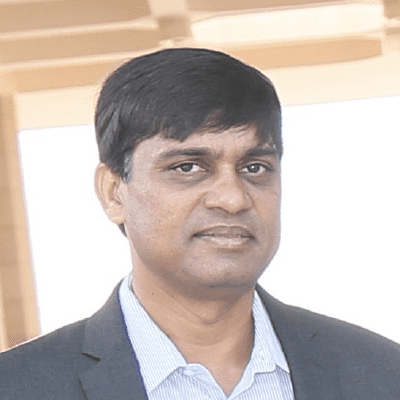
Amaralingeswara Rao Kaka
Leads EDB’s APJ Professional Services, driving efficient, cost-effective migrations through the India-based Migration (more…)

Yuvaraju Maddiboina
Experienced Data Scientist with expertise in Python, Machine Learning, and Data Science, with a background in manufacturing. Holds an M.Tech in (more…)

Abinash Padhi
Data Science professional with 10+ years of experience across domains like automotive, retail, pricing, marketing, and (more…)

Dr. Santosh Nair
Dr. Santosh Nair is an expert in statistical modeling and advanced analytics, with specialization in marketing mix modeling, (more…)

Dr. Sai Hareesh
Dr. Sai Hareesh has 14+ years of experience in AI, Computer Vision, and Deep Learning across defense, (more…)
Continuous Evaluation
This is a globally accredited program to make the participants truly global citizens. At par with international standards and to provide opportunities for global mobility to our participants, we follow an outcome-based education system (OBE). Experiential learning and project-based pedagogy have been employed in the design and delivery of the program.
 The objective of module assessment and evaluation is to objectively assess the learners of the program on their ability to apply the concepts, modeling techniques in various domains and verticals for different business scenarios through a continuous evaluation framework throughout the program. Detailed regulations on earning the credits and GPA’s will be shared during the program.
Admission Process
-
Register by filling up the
online application form -
Go through the documentation process and a screening call with the Director’s office.
-
If selected, you will receive an ‘offer of admission’ letter for the upcoming cohort. Secure your seat by paying the admission fee.
Merit Scholarship
for those who scored
60%
and above in their pre-qualifying exam
Early bird/group/referral
discounts are also available.
Admission Process
Financial assistance and Educational Loans from NBFC’s and Banks are available with interest rate ranging from 9 to 14%. These financial institutions will allow you to repay the educational loan in easy installments and income tax benefits.
Avail hassle-free educational loan to help you to join our Master’s programs to power up your skills to build your dream career.