


Demystifying Ensemble Learning: Bagging vs. Boosting Explained Simply
In machine learning, relying on a single predictive model can sometimes be risky. Just like in real life, where we consult multiple experts before making a big decision, algorithms perform better when they work together. This is the core philosophy behind Ensemble Learning.
Ensemble methods combine the predictions of multiple base models (often called “weak learners”) to create one final, robust model (a “strong learner”). Among the various ensemble techniques, Bagging and Boosting are the absolute heavyweights.
In this blog post, we’ll unpack how they work, look at their core block diagrams, and understand exactly when to use which.
1 What is Bagging? (Bootstrap Aggregating)
"Let's get multiple opinions, each from a slightly different perspective, then take a vote."
Bagging stands for Bootstrap Aggregating. Its main goal is to reduce variance, making it ideal for models that tend to overfit the training data, such as deep decision trees.
How Bagging Works (Click a step to expand)
The original training dataset is randomly sampled with replacement to create multiple bootstrap samples. Some records appear multiple times while others are left out.
A separate decision tree (or another model) is trained independently on each bootstrap sample. Since they don't depend on one another, all models can be trained in parallel.
Each model makes a prediction. Classification uses a majority vote, while regression takes the average of all predictions.
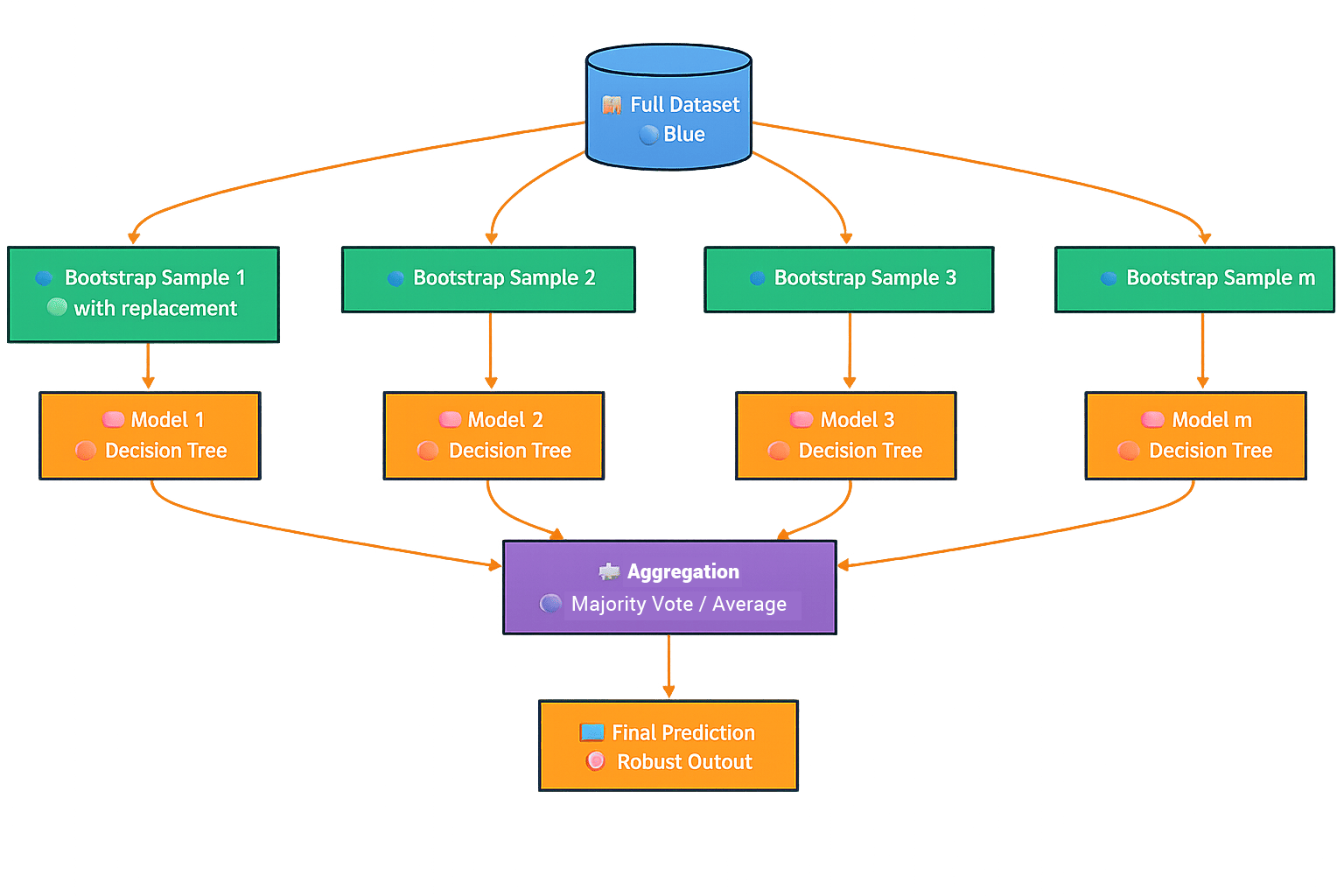
Figure 1: Bagging workflow
2 What is Boosting?
"Okay, you messed up those few questions. Now focus on them and try again."
Unlike Bagging, Boosting is a sequential ensemble technique. Its primary focus is to reduce bias by turning a collection of weak models (models slightly better than random guessing) into a highly accurate strong learner.
How Boosting Works (Click a step to expand)
A base model is trained on the original dataset with equal weights for all data points.
After predictions, misclassified points are recorded.
The algorithm increases the weight of misclassified points. The next model is trained on this re-weighted dataset, forcing it to focus on the "hard" cases.
Steps 2–3 repeat for a set number of iterations. The final prediction is a weighted combination of all models, where better-performing models get more influence.
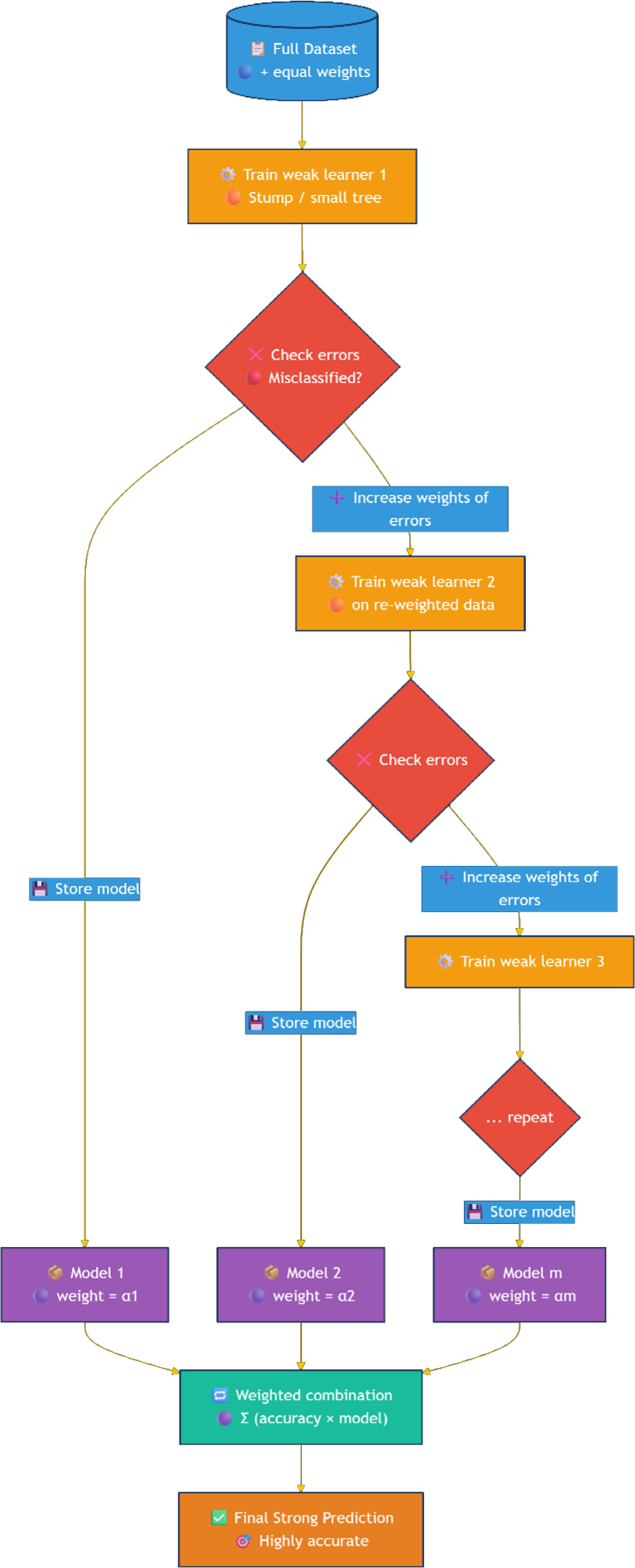
Figure 2: Boosting block diagram
So… Which One Should You Use?
Flip the switch to see which technique fits your model's problem.
Example: Your model is like an over-caffeinated student who perfectly memorizes the homework but panics on anything new. Bagging smooths out that nervous energy.
Example: Your model is like a lazy student who keeps taking shortcuts and missing obvious patterns. Boosting forces it to double down on its mistakes until it gets it right.
Bagging
Best for high-variance models that overfit.
Boosting
Best for high-bias models that underfit.
3Quick Comparison
| Aspect | Bagging | Boosting |
|---|---|---|
| Training style | Parallel — all at once | Sequential — one after another |
| Main goal | Lower variance (stop overfitting) | Lower bias (stop underfitting) |
| Data handling | Random samples with replacement | Re-weights the data after each mistake |
| Combining votes | Simple majority or average | Weighted average (stars get more voice) |
| Loves outliers? | No, but tolerates them | Hates them — can overfit like crazy |