


Learning Has to Be Like Breathing: Pre-Orientation Session at RACE
A Saturday Morning that Set the Tone
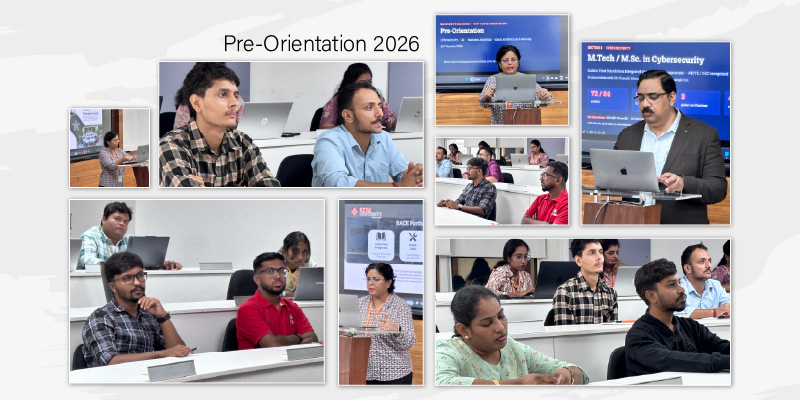
On Saturday, 24 October 2026, REVA Academy for Corporate Excellence (RACE), REVA University hosted a pre-orientation session for prospective participants of its upcoming batches. Learners joined both on campus and online for an hour and a half of candid conversation.
Dr. Shinu Abhi, Director – Corporate Training, RACE, REVA University opened with an introduction to RACE and REVA University. Sandeep, Chief Mentor – Cyber & Cloud Security – RACE | EVP – Terralogic Inc. then took over to walk participants through today’s threat landscape, followed by Dr. Shinu, who covered the programs, projects and career paths.
RACE offers four programs: Artificial Intelligence, Cybersecurity, Cloud and Business Analytics. The programs have been running for five to six years, and the cybersecurity program is now welcoming its 18th batch. With the formal inauguration scheduled for next Saturday, the session was designed to help participants make an informed decision about the path ahead.
Why this Matters Right Now
Sandeep took over by asking participants what they had seen in the news that week. The answers became a tour of today’s threat landscape.
- Data leaks are making headlines. Participants pointed to recent reports of customer data from a large Indian bank appearing on the black market. Sandeep’s point was that no organisation, however robust, can control every entry point.
- AI is now on the attacker’s side. Endpoint security has moved from antivirus to behaviour-based EDR. Today, AI agents and models carry out attacks on behalf of adversaries, from organised groups to state-backed actors.
- Japan’s cyber emergency. After a wave of ransomware attacks, including one on a cloud provider that hit hundreds of businesses, the head of Japan’s National Cybersecurity Strategy Headquarters described the country as being in a state of emergency in cyberspace. Sandeep explained how red, blue and white teams are used in exactly such situations to stress-test critical infrastructure.
- Vulnerabilities don’t wait. Two critical PHP remote code execution flaws had RACE’s own industry clients asking for urgent patches, with one client alone running around 100 applications to check. Sandeep stepped out mid-session to handle it, a live reminder of what the job demands.
- The eMudhra episode. eMudhra issues digital certificates that secure SSL/TLS communication for banks, PSUs and many other organisations. After researchers showed that private keys behind some of its certificates could be recovered in under a second, browsers blocked them and eMudhra announced its exit from the global SSL/TLS certificate business. Sandeep added that quantum computing will put today’s encryption under pressure sooner than many expect.
The discussion then turned to personally identifiable information (PII): anything tied to an individual, such as Aadhaar, PAN, phone numbers, addresses and photographs. India’s Digital Personal Data Protection (DPDP) Act, Singapore’s PDPA, Europe’s GDPR and US state laws like CCPA all require PII to be safeguarded, with consent needed to process it. A leak that organisations once shrugged off, because no account or transaction data was exposed, can now attract penalties running into hundreds of crores.
Sandeep cited this week’s PwC incident as a case in point. A third-party platform hosting PwC employees’ learning records was breached, with a ransomware group claiming to have taken 590 GB of data. PwC said no client or sensitive data was affected, but Sandeep’s point was clear: employee training records are still personal data, and they need the same protection.
The message was clear: security is no longer just a perimeter firewall. It has to be part of every professional’s DNA. Developers are now expected to test their own code against known vulnerabilities, and boards are making room for cybersecurity experts, with AI experts likely to follow.
The Half-Life of a Skill
Dr. Shinu Abhi then took the conversation from threats to careers, with an idea that resonated across the room: skills now have a half-life. A generation ago, one skill could sustain a whole career. Today, a skill may stay current for less than a year. It is also the theme of the latest issue of RACE’s newsletter, Retina, released the same day.
The hiring trends shared were striking. Plain IT hiring has dropped by 50 to 60%, while hiring for AI and automation roles, including at GCCs, has grown by 40 to 50%. AI is changing some jobs, but it is also creating new ones for professionals who can set up, monitor and improve AI systems.
This is why RACE’s programs are no longer separate, isolated tracks. AI touches everything from infrastructure to deployment, so AI and cybersecurity are now taught together, and every program is designed with AI at its core.
Inside the Four Programs
RACE offers four programs in Artificial Intelligence, Cybersecurity, Cloud and Business Analytics. Each runs for about 18 to 24 months, one module at a time, as a recognised university degree with global certifications built in, and every curriculum is designed to stay relevant for at least two to three years. Learners move from strong foundations to hands-on labs, a campus Security Operations Centre, a cyber range and real-world AI builds, with AI woven through every program. Explore the full program details here.
Projects that Leave the Laptop
For many participants, the highlight was the capstone work. AI, Cyber and Business Analytics each include three capstones, one of them a publication. Cloud has one project plus a publication, since its certification load is already heavy.
- Real problems. Around 40 to 50% of projects are sponsored by participants’ own companies. Participants were encouraged to sit with their managers and bring a real problem statement. One example shown was a stroke-detection model built with deep learning on a healthcare company’s ECG and imaging data.
- A large project library. RACE has a repository of about 745 projects across AI, analytics, cyber and cloud, each with a report, deck, Git repository and demo. If you have no idea where to start, you can pick one and build on it.
- One-on-one mentorship. After a panel helps sharpen your idea, you get an industry mentor for about two months to turn it into a working demo.
- Publications and patents. About 110 projects have been published, in venues like IEEE and Springer Nature. If an idea is patentable, the university covers the cost from filing to grant and shares the stake. Around 5% of projects go on to commercialisation.
The pitch was simple: your interview does not have to be just talk. It can be a demo of something you built, with your name on a published paper.
A 15-year Map, and the Price of Climbing it
Every program comes with a career pyramid, and each module is mapped to a role on it. Participants were asked to place themselves on the map and look 15 to 20 years ahead.
| Experience | Where you should be | Cyber example |
|---|---|---|
| 0–5 years | Engineer or analyst | SOC analyst, pen tester, vulnerability analyst |
| 5–10 years | Senior or lead | Incident response lead, red team lead, cloud security lead |
| 10–15 years | Architect, designing the system rather than working in it | Application security architect |
| 15+ years | CXO | CISO, CTO, CIO |
The message was blunt. If you are doing the same work after five years, you have become the bottleneck. The Peter Principle came up too: people get promoted into jobs they do not yet know how to do, so the transition is exactly when you must upskill hardest.
Then came the line repeated all morning: pay the price. RACE is ranked number one on ROI, and Dr. Shinu noted that a program like this makes sense if you are aiming for a 50 to 100% jump, not a 10% hike. But mentors can only walk part of the way. The rest is late nights of practice until a skill sits at your fingertips.
The best illustration was NVIDIA’s small walking robots. Nobody taught them to walk. They fell thousands of times, were penalised for falling and rewarded for staying up, and learned. The question to participants was simple: if a robot can keep falling until it walks, what is stopping us?
Dr. Shinu also stressed the power of the ecosystem. Learning alone from YouTube can take a learner anywhere. Learning alongside mentors like Sandeep, who has seen more attacks than most professionals will in a career, lets participants see the field through experienced eyes.
Support that Continues Beyond the Degree
RACE’s commitment does not end at graduation. Alumni stay connected, job openings are posted on the LMS (roles from EY and LKQ were live on the day of the session), and RACE runs mock interviews before participants apply, as many times as they need. Every module comes with pre-readings, recorded sessions, quizzes, assignments and an end-of-module exam.
Dr. Shinu closed the session with a thought worth keeping: learning has to be like breathing, so natural you barely notice it, yet purposeful enough that you will bear the effort because the outcome is worth it.
RACE thanks Dr. Shinu Abhi, Sandeep and everyone who joined, on campus and online. We look forward to welcoming the new batches at the inauguration next Saturday.