


From Chatbots to Coworkers: The AI Trends Defining Late 2026
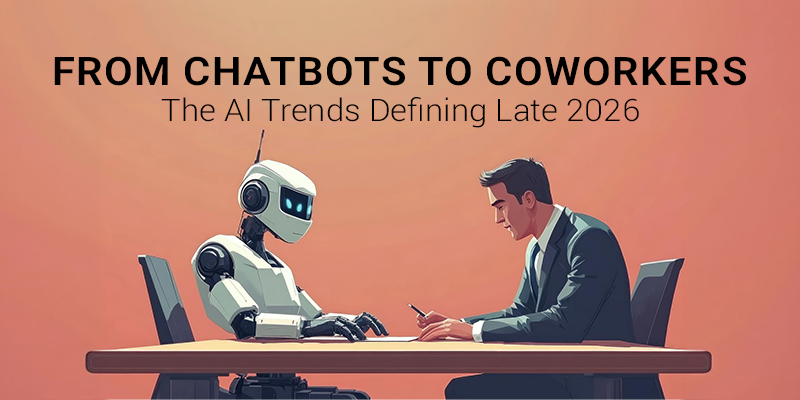
The race for smarter models is no longer the whole story. As AI starts acting on our behalf, the real contest is over who it answers to, who pays for it, and who sets the rules.
A year ago, the AI conversation was dominated by a race between frontier labs to ship the smartest model. That race hasn’t stopped, but in November 2026 the more interesting stories are happening around the models: who gets to let AI act, who pays for the infrastructure, who controls the weights, and who writes the rules. Here are seven trends worth paying attention to.
1. AI agents are moving from demo to deployment — slowly

“Agentic AI” — software that plans and carries out multi-step work across tools, rather than just answering a prompt — is the defining enterprise theme of 2026. Gartner’s widely cited forecast is that around 40% of enterprise applications will have task-specific agents built in by the end of this year, up from under 5% in 2025 (Prefactor).
But the headline numbers deserve a second look. Surveys of executives suggest roughly half of organisations have agents in production (Prefactor), while a much larger survey of over 120,000 enterprise respondents found fewer than one in ten companies running agents in production, with most still exploring or piloting (TechRepublic). The gap tells you something: intent is nearly universal, but turning a promising pilot into a reliable, integrated workflow is still hard.
The practical takeaway: the winners in 2026 aren’t the companies with the most agents, they’re the ones that connected agents to real systems (ERP, CRM, ticketing) and measured the results.
2. The gatekeepers are pushing back

As personal AI assistants get good enough to buy things on your behalf, businesses are deciding whether to let them in. The clearest example came on November 11, when United Airlines announced it would block unauthorized third-party AI agents from booking, changing or purchasing flights — on its own website and app, and through travel agencies and aggregators (Skift, PhocusWire).
United cited privacy, security and aviation regulations, and its CEO has signalled he doesn’t want a new AI “middleman” sitting between the airline and its customers (SecNews). Agents can still search and show you United fares; a human just has to complete the purchase (Business Traveller).
Expect more of this. The agentic web needs rules about identity, authorization and liability that don’t exist yet, and until they do, large consumer brands will default to protecting their customer relationships and their data.
3. AI is quietly becoming a search engine

In early November, OpenAI’s ChatGPT consumer lead said ChatGPT now handles roughly one-fifth as many search-like queries as Google, and that weekly users grew from about 1 billion to 1.2 billion in just two months (Search Engine Roundtable).
That figure comes with caveats: OpenAI didn’t disclose how it measured Google’s volume, Google says its own search volume is at an all-time high, and “one-fifth of the queries” is not the same thing as “one-fifth of the market” (Search Engine Journal). Earlier independent estimates put the ratio closer to 12% (Ahrefs). Still, the direction is unmistakable, and it’s already reshaping marketing — OpenAI has begun letting businesses claim and manage their presence inside ChatGPT (MarketingProfs), while Google is adding more ads to its own AI search mode (Search Engine Roundtable).
For anyone who depends on search traffic, “how do I show up in AI answers?” is now as important a question as SEO was a decade ago.
4. Open-weight models have closed most of the gap

Open-weight models — ones whose weights you can download and run yourself — have gone from a budget alternative to a serious option at the frontier. The past few weeks alone brought Moonshot AI’s Kimi K3.1 Pro, which tops several open-weight leaderboards (BenchLM), and Mistral Large 4, a model of over a trillion parameters that companies can run internally for free on a single high-end GPU node, with a separate licence needed to serve it to customers (BERI).
Two caveats keep this honest. First, “open” usually means open weights under a custom licence, not fully open source — read the licence before building (Kanerika). Second, the biggest models need datacentre-class hardware, so “self-hostable” doesn’t mean “runs on your laptop.” Even so, more well-funded engineering teams are choosing self-hosted open models over per-seat subscriptions for things like coding assistants, mainly for cost and data control (OpenTools).
5. The infrastructure boom is running into its first real doubts

The money being poured into AI infrastructure is staggering. Based on their latest guidance, Amazon, Alphabet, Microsoft and Meta are on track for roughly $730 billion in capital spending in 2026 — nearly double the $376 billion they spent in 2025 — and Alphabet has already said spending will rise significantly again in 2027 (Walnut AI Capex Tracker).
What changed this autumn is how that spending is funded. Capex has begun to outrun the cash these companies generate (Tech Insider), and Microsoft, Meta and Oracle all sold bonds in the first week of November (Walnut). Investors aren’t questioning whether AI demand is real; they’re asking how long spending can keep climbing before cash flow, credit markets or the power grid push back. Electricity in particular has become a hard constraint on how fast new capacity can come online (BTW Media).
6. Regulation is arriving — with some deadlines pushed back

In Europe, the bulk of the EU AI Act became applicable on August 2, 2026, including transparency rules and enforcement powers over general-purpose AI models (Tech Jacks Solutions). At the same time, the EU passed its first major amendment, the “Digital Omnibus on AI,” which took effect in late July (National Law Review) and delays the rules for many high-risk AI systems to December 2027 (and some product-embedded systems to 2028) (Morgan Lewis).
One deadline is close: generative AI systems already on the market before August 2 have until December 2, 2026 to comply with the Act’s requirements to mark AI-generated content in a machine-readable way (McCann FitzGerald). If you ship generative AI into the EU, that’s about two weeks away.
National regulators are getting set up too — Ireland, for instance, established its own AI Office this summer to enforce the Act locally (McCann FitzGerald).
7. Oversight is becoming a product category

The common thread through all of the above is control. As AI systems take actions instead of just making suggestions, enterprises want to see what an agent did, limit what it’s allowed to do, and undo its mistakes. In surveys, security and governance now rank as the top factor when companies evaluate agent platforms (CrewAI).
That has spawned a new layer of tooling: agent identity and permissions, audit logs, rollback, and even AI “auditors” that watch other AI agents. Early results are mixed — automated monitors catch real misbehaviour but can also swamp human reviewers with false alarms (OpenTools) — but the direction is set. In 2026, trust is the feature.
What to watch next
- December 2: the EU’s AI-content marking grace period ends.
- Q4 earnings and 2027 capex guidance: will spending plans keep accelerating, or start to flatten?
- More “agent policies”: whether other airlines, retailers and banks follow United — or instead build official ways for AI agents to transact.
- The open vs. closed gap: whether the next round of frontier releases widens the lead of proprietary models again.
The short version: AI in late 2026 is less about a single breakthrough and more about AI becoming infrastructure — something that books, searches, spends and gets regulated like any other part of the economy. The hard problems now are trust, cost and control.
Build the agents, don’t just read about them
Every trend above points to the same skills gap: organisations want agents in production, but few people can design, connect, govern and deploy them reliably. That is the gap the Certified Agentic AI Engineer (CAAE) program at RACE (REVA Academy for Corporate Excellence), REVA University is built to close.
- Hands-on with the real stack: build single and multi-agent systems with LangChain, LangGraph, CrewAI and AutoGen.
- Production-ready deployment: take agents to AWS, Azure and GCP, with LLM/RAG workflows and enterprise orchestration.
- Built for working professionals: about 60 hours in a hybrid format (online and on campus in Bengaluru), mentored by experienced AI practitioners.
- A portfolio, not just a certificate: a project-based approach and a capstone you can show employers. One Batch II graduate, a practising chartered accountant, built a RAG advisory assistant for the NBFC sector that cites regulatory guidelines.
You don’t need to be a career engineer to start. Professionals from finance, consulting and other fields have used CAAE to build AI agents for their own domains.