


When Saturday Turned Into a Live-Fire Classroom: Inside the RACE Sandbox
What does it take to convince seasoned professionals to trade a Saturday morning for a classroom?
“The best learning doesn’t begin with slides, it begins with curiosity.”
When professionals choose to spend their weekend in a classroom, they’re looking for more than theory. They want practical insights, real conversations, and experiences they can immediately apply to their work. It takes a program willing to put the real thing in front of you first, and let the questions follow. That’s precisely what REVA Academy for Corporate Excellence – RACE, REVA University delivered last Saturday, the 18th: a single day engineered to move from context, to classroom, to live fire, to a system built entirely by the Academy’s own people.
Setting the Stage
True to RACE tradition, the day opened with an introduction, the same grounding walkthrough of the Academy’s mission, its industry partnerships, and its philosophy of learning-by-building that anchors every cohort before the technical deep dives begin. It’s a small ritual, but an important one: before you learn the tools, you understand why you’re here.
Where the Modules Come Alive
With the introduction done, participants were taken into the ongoing classrooms to experience Saturday’s live sessions firsthand, sitting in on the modules already in motion across the batches, from AI systems and cloud deployment to threat intelligence and capstone reviews. It was hands-on from the first minute: no observing from the back of the room, but stepping directly into the sessions as they were already running, batch after batch working through its own slice of the curriculum in parallel, cyber threat intelligence and threat hunting exams, cloud administrator migrations, hybrid cloud deployment, generative AI, fuzzy systems and reinforcement learning, marketing and retail analytics, and a capstone cohort deep in its final bootcamp and viva presentations. Thirteen batches, thirteen different journeys, all converging under one roof.
Batches · One Roof
- Cyber Threat Intelligence
- Threat Hunting Exams
- Cloud Administrator Migrations
- Hybrid Cloud Deployment
- Generative AI
- Fuzzy Systems & Reinforcement Learning
- Marketing & Retail Analytics
- Capstone Bootcamp & Viva
The Room Where Questions Get Sharp
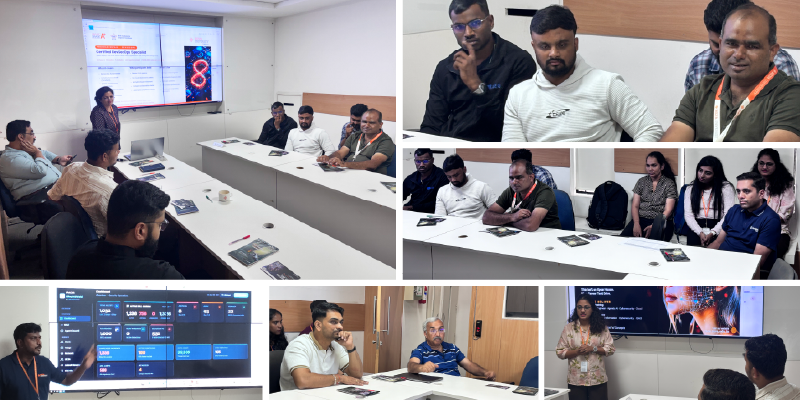
Classroom time done, the RACE Sandbox professionals filed back into the SOC room, and it’s there that the day’s sharpest conversation really got going.
Among them sat professionals from Infosys, Capgemini, and a handful of other industries, sharp, curious, and unwilling to let a single slide pass without interrogation. With such a cross-section of the industry back in one room, the questions carried the weight of real, varied experience, each person testing the material against the problems they’d actually seen back at their own desks.
“What frameworks are we actually supposed to be building on?”
The question that shaped the room
It wasn’t a throwaway question: it shaped much of what followed, as mentors walked through the architectures and reference frameworks that separate a working AI system from a research demo.
That discussion kept circling back to a bigger dilemma: should I specialize in AI, or in cybersecurity?
It’s a fair question, and this cohort refused to let it stay abstract. The conversation on AI for Cybersecurity made the case that the question itself may be the wrong one. Today’s threat landscape doesn’t respect the boundary between the two disciplines, and the strongest practitioners are the ones who can move fluidly between them, using AI to detect what a human analyst would miss, and using security instincts to know when AI itself can’t be trusted.
That thread pulled naturally into Agentic AI, systems that don’t just respond, but act. Participants dug into what happens when autonomous agents are handed real decision-making power, and why that autonomy is exactly what makes securing them so different from securing traditional software.
The technical backbone of the room’s conversation came together in three more distinct threads:
-
MITRE ATT&CK made its expected appearance, the industry’s shared language for describing adversary behavior, and sparked a lively back-and-forth on how threat modeling teams actually use it to map real attacks rather than just study it as theory.
-
And in a discussion that pushed the room a few years into the future,
Post-Quantum Cryptography (PQC) was discussed across its three most urgent fronts: identity, data, and AI, a reminder that the cryptographic assumptions everyone builds on today have a shelf life, and the organizations preparing now will be the ones still standing when it expires.
Watching the Machine Think
With the room already warmed up, it was time to watch it all breathe. The live SOC demo, a walkthrough of RACE Blackshield AISOC, an autonomous multi-agent, AI-driven security operations platform presented by Belavendra Jordan C, Senior Technical Lead, RACE, turned the room into a war room. Real alerts. Real triage. Real decisions, made in seconds, with no analyst clicking a single button.
The room watched a 15-agent pipeline take a live alert from detection through an 8-agent council deliberation to an automatic FortiGate block, the kind of closed-loop response that usually only exists in a slide’s promise, not in front of a live audience. Kill-chain correlation stitched isolated alerts into a single attack narrative, and the platform’s own honesty stood out just as much as its capability: the team was upfront about what still breaks, including a known IOC pipeline bug and the limits of validating an AI system against itself.
That honesty is exactly what set up the two sharpest questions of the session, fired off the moment the demo ended:
Both questions cut straight to the heart of trusting autonomous systems in a security context, and both got answered with data, not reassurance. The response leaned on the platform’s kappa (κ) study, an interrater reliability analysis where two independent LLM raters scored the same alerts separately, and their agreement was measured statistically rather than assumed. Where that agreement broke down, disagreements were routed straight to a human, not smoothed over. On the false-positive question, the answer pointed to the platform’s 384-dimension k-NN (k-nearest neighbors) semantic memory, a model that checks a new alert against a library of previously verified incidents, so a “false positive” call isn’t a guess, it’s a comparison against evidence the system has already reasoned through before. Together, the kappa study and the k-NN model gave the room something rare in an AI demo: a real, numbersbacked answer to “why should I trust this?” instead of a shrug.
Built In-House: Meet RIA
From the SOC room, the energy carried straight into the live project showcase, headlined by RIA, REVA Intelligent Assistant, a homegrown demonstration of what happens when the Academy’s own people build the kind of intelligent, agentic systems being discussed all day. It wasn’t a case study borrowed from someone else’s company. It was proof, built in-house, that the ideas from the classrooms and the SOC room alike aren’t hypothetical.
The Ones Who Made It Out the Other Side
No RACE Saturday is complete without the conversations that don’t fit in a syllabus. The industry mentor interactions, featuring Dr. JB Simha and Sandeep Vijayaraghavan, opened this final stretch of the day with the kind of perspective only years in the field can offer, grounding everything discussed since morning in what actually plays out on the job.
That was followed by the alumni interaction with Ameen and Chetan Niloor, which gave participants something a framework never can: a straight, honest account of what the path actually looks like after the certificate is printed, the pivots, the interviews, the moments of doubt, and the payoff on the other side. Together, the two conversations closed the day the way it opened, with real people, real systems, and real questions still worth asking on a Monday morning.
By the time the last session wrapped, the question that had followed the room all day, AI or cybersecurity, had quietly answered itself. Today’s RACE Sandbox wasn’t about choosing a side. It was about learning to move between both, fluently, because that’s exactly what the field is going to demand next.